


 UA
UA FR
FR DE
DEby Anastasiia Sheremok and Camille Gilles, Promote Ukraine’s interns 2026
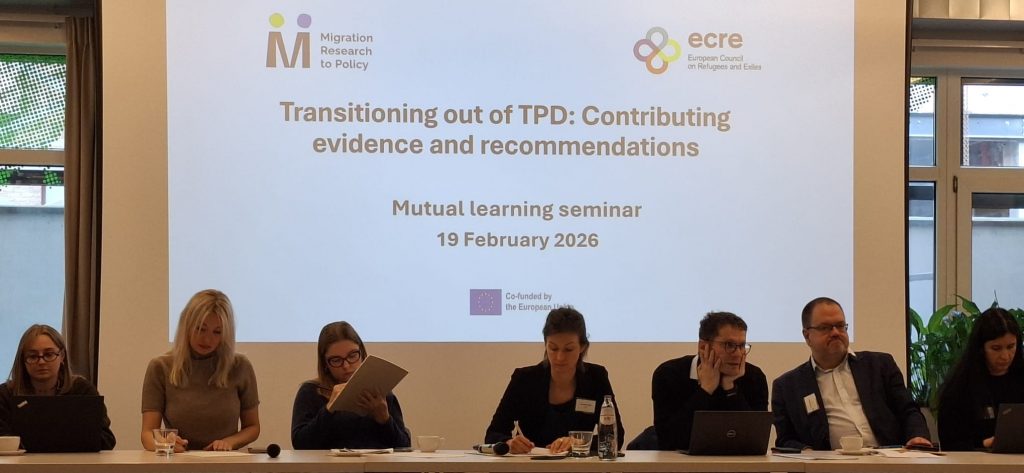
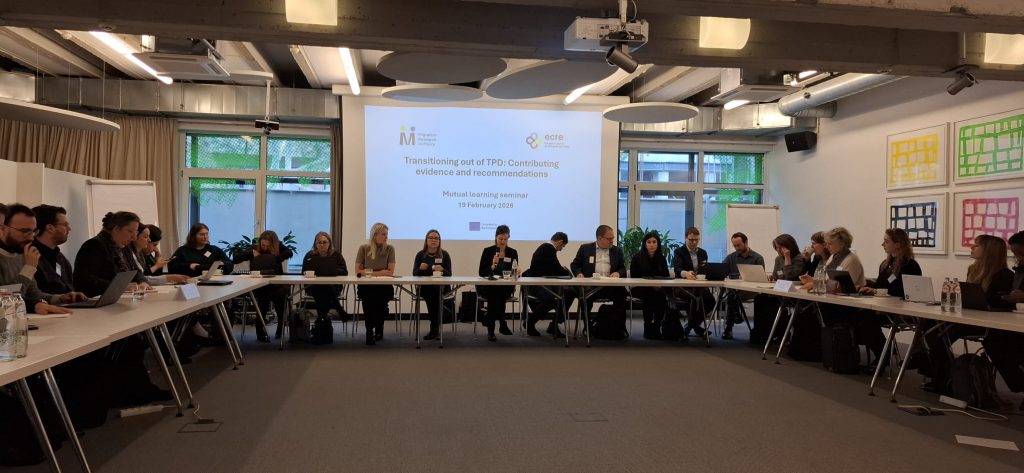
On the 19th February, the Promote Ukraine team attended the Transitioning out of the Temporary Protection Directive seminar organised by the European Council on Refugees and Exiles (ECRE). This blog summarises the findings of the seminar, with particular focus on the risks associated with transitioning out of TPD in 2027.
The biggest challenge for the European Union is the question of what happens when “temporary” protection becomes prolonged.
At the heart of the discussion are ways to transition out of TPD to other statuses: whether national, international, or EU-wide. They are needed because prolonged temporality creates uncertainty for both host states and beneficiaries of the temporary protection. As for the letter, they face instability in housing, employment, and social integration. For example, employers may hesitate to offer long-term contracts to individuals whose status is temporary. And the worst issue of all: if no transition mechanisms are in place before 2027, beneficiaries risk becoming illegal migrants.
There is a limit to what the EU can coordinate. Under Article 4(2)(j) TFEU, the EU and its Member States operate within a framework of shared competence in matters of migration. Residence permits to which Ukrainians are most likely to transition are primarily regulated at the national level, within an EU legislative framework (e.g., the Long-Term Residents Directive, the Blue Card Directive, and the Family Reunification Directive). While Member States are increasingly acting under national interests, without coordination, different national statuses may start a chain of chaos. This is the very scenario the TPD originally sought to prevent.
The Risk of Irregularity After 2027
The fundamental question is whether Member States will establish transition and return mechanisms beforehand, or react only when the TPD is nearly expired. The scope defining the rules for temporary protection could still evolve with the will of Member States. But in the current European political climate, this is not always the case.
In several Member States, elections of significant national importance are approaching. This is particularly the case in Hungary, Bulgaria, Sweden, and France. In this context, migration issues become particularly sensitive and are used for political purposes. While it is urgent to find solutions for the transition out of the TPD, in several Member States, the debate is paralysed by national-level controversies over migration. Ukrainian beneficiaries of temporary protection (hereinafter — TPBs) become the victims of this situation until solutions are found.
If temporary protection ends without transition pathways, 4.3 million Ukrainians currently under temporary protection in the EU may enter a legal vacuum. This could lead to secondary movements across Member States, administrative overload, and, of course, political backlash.
It is not in the interest of host countries to create irregular populations. Yet risks are real. According to UNHCR, one in five Ukrainians employed in host states may be working without a regular contract.
The Legal Architecture of Extension
The Council Recommendation, issued last year, was part of a broader package consisting of three documents.
First, a Communication appointed a Special Envoy for Ukraine. The role of the Special Envoy is to act as a point of contact between Member States and Ukraine, with a mandate to assess challenges on the ground.
Second, the EU agreed on the proposal to extend temporary protection until 2027. Article 4(2) of the TPD was chosen as the legal basis – it allows the Council to extend temporary protection for up to one additional year. This was disputed because extending the regime beyond three years significantly exceeds the maximum temporal limit explicitly established by the TPD. There is an opinion among legal scholars that this provision lacks the authority to justify a four-year duration without a legislative amendment (p. 4). Using such a broad interpretation to prolong the status undermines the directive’s temporality and creates legal uncertainty for displaced persons.
The recitals accompanying the extension proposal contain three key elements:
- The obligation to provide updated data via the Temporary Protection Platform established in 2022.
- The possibility for the Council to end temporary protection should conditions in Ukraine allow return.
- A clarification that a second Member State may refuse a residence permit request if the applicant already holds protection in another Member State (as further specified in the Krasiliva case (C-753/23).
Importantly, the scope of temporary protection is not defined in the Directive itself but in the Council Implementing Decision. This means that the scope can be legally amended.
Third, the Council Recommendation itself, which focuses on transition measures and return coordination.
Transition to Other Statuses
Member States are encouraged to facilitate applications to alternative legal statuses before temporary protection ends. These may include national residence permits, permits issued under existing EU migration directives, and special ‘omnibus’ permits (as seen in Poland). One of the problems is that the EU cannot create a new residence permit at the Union level without a legal basis.
The Long-Term Residents Directive (LTRD), which is conditioned upon employment, is currently under recast negotiations. Currently, TPBs are not allowed to apply for a long-term residence under the Directive. Article 4 of LTRD sets out the requirement for five years of continuous and lawful residence. Article 5 of LTRD defines the conditions for acquiring the status, stipulating that the applicant must prove they have stable and regular resources (income) and health insurance. The LTRD recast will include TPBs within its scope and allow time spent under this status to count fully toward the residency threshold.
As this Directive is subject to employment, it is important to note that there are extremely large differences in employment rates for TPB within the EU. According to data from the OECD Secretariat (p.10), some Member States have very high employment rates, such as Poland (78%), Lithuania (72%), and Sweden (66%). On the other hand, Denmark, the Netherlands, France, and Austria have employment rates for TPBs of between 60% and 40%. However, in some countries, this rate is below 40%, such as in Ireland (35%), Germany (31%), and Spain (17%).
These differences can be explained by the general conditions required to enter the labour market, which vary from one country to another, the number and profile of refugees in the country, and the support measures put in place at the local and national levels.
Voluntary Return and Unity Hubs
The Directive foresees voluntary return in Articles 21-22 TPD. According to Elena Gobbetti, Policy Officer for Temporary Protection Directive, such a return must be linked to the reconstruction and reintegration of Ukraine.
Proposed measures include short exploratory visits to Ukraine, a transition period allowing residence for one year after protection ends, and coordination through “Unity Hubs”—information centres that already operate in Germany, the Czech Republic, and Spain.
Protecting the Most Vulnerable
While the transition out of the TPD places all TPBs in a precarious and difficult position, it is the most vulnerable who are likely to be hit hardest.
The TPD contains specific clauses regarding vulnerable persons, including those unable to travel. Member States are legally obliged to provide for such individuals. Special considerations include minor children completing education, unaccompanied minors, and persons unable to return due to medical or social vulnerability. However, Member States differ in interpretation and implementation. There is a risk that protection for vulnerable groups may become uneven across the Union.
Dr. Marta Barandiy pointed out that the EU would be much more favorable to keeping the most adapted TPBs (those contributing to the national economy of Member States by working and paying their taxes, the youngest and most well-integrated), while the most vulnerable (the children, the elderly, and the sick) are more likely to return to Ukraine. This is particularly evident in the difficulties faced in family reunification or in obtaining temporary protected status for babies born after February 24, 2022 (notably in Belgium), as well as in obtaining assistance for children caring for their elderly parents.
With the transition out of the TPD, these sorts of issues are likely to multiply within Member States. As a shared competence, migration is regulated by a framework defined at the European level, but it is up to Member States to implement and enforce it themselves.
The European level appears to be the most appropriate for making fair and equitable progress across all Member States by coordinating their efforts in the interests of TPBs.
To be truly beneficial to TPBs, its actions should also consider making it easier for them to access the labour market by lowering the current criteria for obtaining a work permit and improving the recognition of qualifications, thereby avoiding TPBs from being employed in jobs below their level of qualification in the future. The EU will also need to work with Ukraine to protect returnees, particularly to ensure that they can retain the benefits of their years spent working in the EU (notably by keeping their pensions and rights).
Marta Barandiy also pointed out that many organisations working directly with TPBs are well aware of these issues and could efficiently communicate them to European and national authorities. However, civil society is not yet sufficiently heard, due to a lack of platforms or the necessary means to amplify its voice. This must change so that TPBs are protected as the EU has promised.
Conclusion: Simpler and Kinder Solutions
The extension to 2027 bought much-needed time. But even having this time, the Member States didn’t manage to resolve the dilemma. Temporary protection was designed as an emergency mechanism. Four years later, the EU faces a challenge: how to transition from temporality without producing fragmentation. Without early planning, the end of temporary protection could significantly increase the number of illegal migrants in the EU.
Several points are crucial to enable TPBs to be better received and supported in obtaining temporary protection and benefiting from their rights in their host country.
First, deadlines must be anticipated, and solutions proposed several months in advance (8-9 months). This reduces the stress and anxiety generated by complex procedures.
Second, it is essential to take into account that the people undertaking these procedures are likely to be deeply affected or even traumatised by the violence they experienced before leaving Ukraine. Their mental health must be protected by adapting the procedure to avoid additional suffering due to stress.
Third, it would be highly desirable to open more centres or information points for TPBs seeking information so that they can obtain transparent communication about status changes directly and more easily than via accessible transition mechanisms (including both digital and offline portals). Indeed, the lack of information and the complexity of the administrative procedures currently prevent many TPBs from benefiting from their full rights in the EU, including safeguards for family reunification.